Short answer: usually yes, with permission — most universities and professors allow students to record lectures for personal study. But the details depend on where you study, your institution's policy, and how you use the recording. Here's the landscape, in plain language. (This is general information, not legal advice.)
The three layers of rules
- Recording-consent law. In the US, federal law and most states follow "one-party consent" — you may record a conversation you're part of. But eleven states, including California, Florida, Illinois, Massachusetts, Pennsylvania and Washington, require all-party consent in some settings. Other countries have their own rules, and lectures sit in a gray zone between "public talk" and "private conversation" — which is why the next two layers matter more in practice.
- University policy. Many universities state explicitly when students may record: some allow it by default, some require the instructor's OK, and nearly all restrict sharing. Search "your university + lecture recording policy" — it's usually a one-page document.
- The professor's consent. Lecture content is the instructor's intellectual property. Asking first is both courteous and, in many institutions, required. The overwhelming majority say yes to personal-study recording.
Special cases worth knowing
- Disability accommodations: if you have an approved accessibility accommodation that includes audio capture, instructors generally cannot refuse it. Your campus accessibility office is the authority here.
- Classmates' privacy: recordings that capture other students' questions or presentations can implicate student-privacy rules (FERPA in the US). Recording the lecturer for private study is the safe zone; publishing classmates' voices is not.
- Sharing and posting: permission to record is not permission to distribute. Uploading a professor's lecture to YouTube, a group chat or a note-selling site can violate copyright and university codes even where recording was fine.
The etiquette that makes everyone comfortable
- Ask once, at the start of the course: "Do you mind if I record for my own study? I'm using an app that transcribes so I can follow better."
- Keep the phone visible on the desk — nothing hidden.
- Keep recordings for yourself and delete what you don't need after exams.
Recording responsibly with Clearly
- Get your professor's OK (or check your university's recording policy) before the first recording.
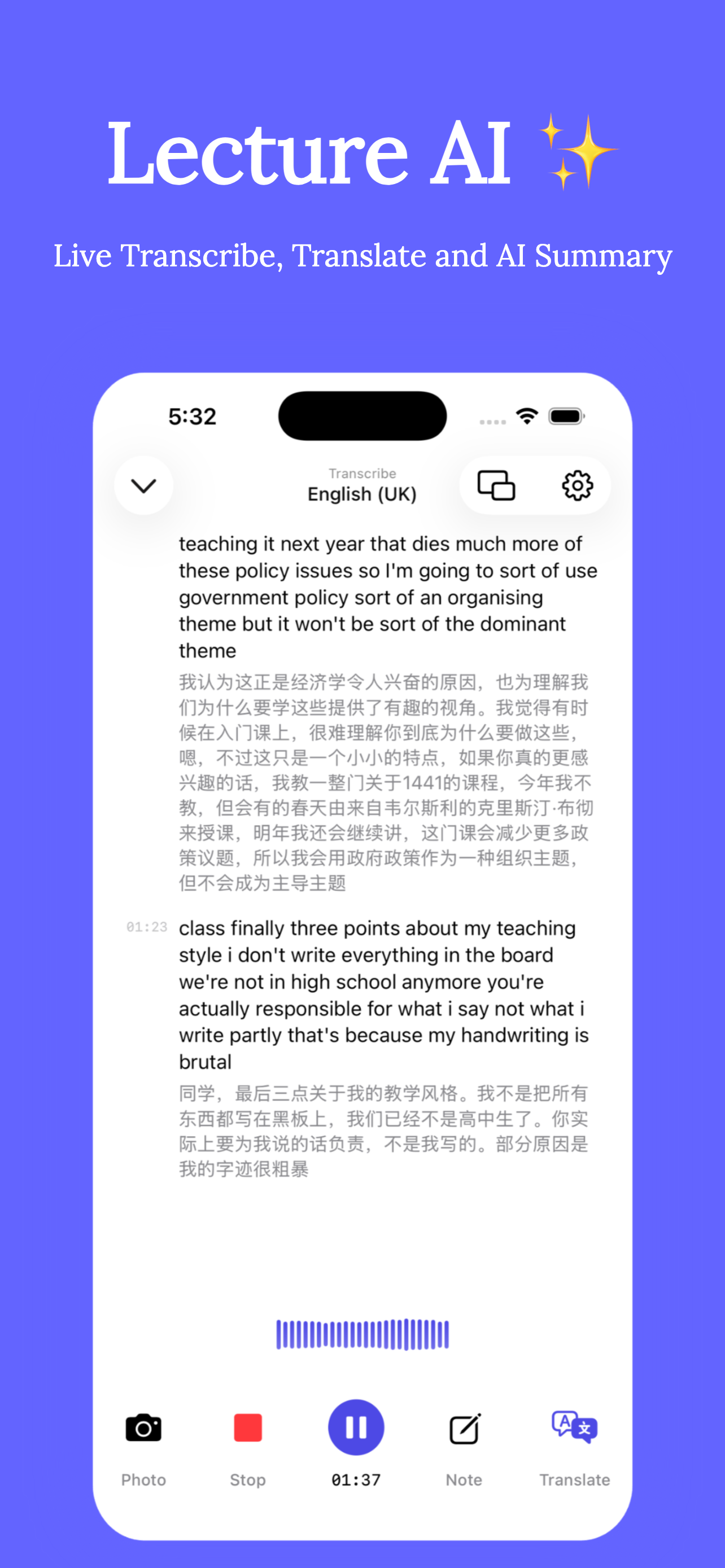
- Record with Clearly openly — phone on the desk, live transcript visible. Many professors appreciate seeing it's a study tool, not a camera.
- Your recordings, transcripts and AI notes stay in your library for personal study — nothing is published anywhere.
- Use the AI summary and transcript for revision, and don't redistribute the professor's content.
One sentence to remember: record openly, with permission, for your own study — and never share without asking. That keeps you inside the rules in practically every jurisdiction and institution.
Get Clearly free on the App Store
Live transcription, real-time translation in 75+ languages, AI summaries and an AI tutor — on iPhone & iPad.